One vendor holds the license to sell hotdogs throughout Fenway Park, home of the Boston Red Sox. From long experience, the vendor knows that demand at a sold-out game is
Demand per game\(Q^d(p)=55{,}000-10{,}000p\)
The vendor's marginal cost of serving a hotdog, covering the sausage, bun, condiments, plate and napkin, is $1.50 whatever the quantity.
Question 1
How many hotdogs will the vendor sell, and at what price? If the vendor's fixed cost of serving a game is $500, what is its profit?
Reveal the solution
Inverse demand is \(p(Q)=5.5-Q/10{,}000\), so revenue and marginal revenue are
Monopoly output and price\(5.5-\dfrac{Q}{5{,}000}\)\(=\)\(1.5\)\(Q^m\)\(=\)\(20{,}000\)\(p^m\)\(=\)\(5.5-\dfrac{20{,}000}{10{,}000}\)\(=\)\(3.5\)
Profit per game\(\pi^m\)\(=\)\(3.5\times20{,}000-(500+1.5\times20{,}000)\)\(=\)\(70{,}000-30{,}500\)\(=\)\(39{,}500\)
The vendor sells 20,000 hotdogs at $3.50 and earns $39,500 a game.
Question 2
Suppose the vendor can expect this profit at every one of the 81 home games in a season. If Red Sox management understands the hotdog business, how much could it charge for the franchise?
Reveal the solution
Up to $39,500 a game, or \(81\times39{,}500=3{,}199{,}500\) dollars a season. If many potential vendors with the same costs compete for the license, the bidding pushes the fee up to the whole profit.
A flat fee raises the vendor's total cost but not its marginal cost. Marginal revenue and marginal cost are unchanged, so the price stays at $3.50 and output at 20,000. The fee only decides who collects the monopoly profit: the vendor or the team.
Question 3
Suppose the vendor has only 10,000 hotdogs to sell on a particular night. How many does it sell, and at what price?
Reveal the solution
Compare marginal revenue and marginal cost at the limit:
At 10,000 hotdogs\(MR(10{,}000)\)\(=\)\(5.5-\dfrac{10{,}000}{5{,}000}\)\(=\)\(3.5\)
That's above the marginal cost of 1.50, so every hotdog up to the limit adds to profit and the vendor sells all 10,000. The price at which 10,000 sell is \(p(10{,}000)=5.5-1=4.50\).
The vendor can't sell more than 10,000 hotdogs, so it raises the price until buyers want exactly 10,000.
Question 4
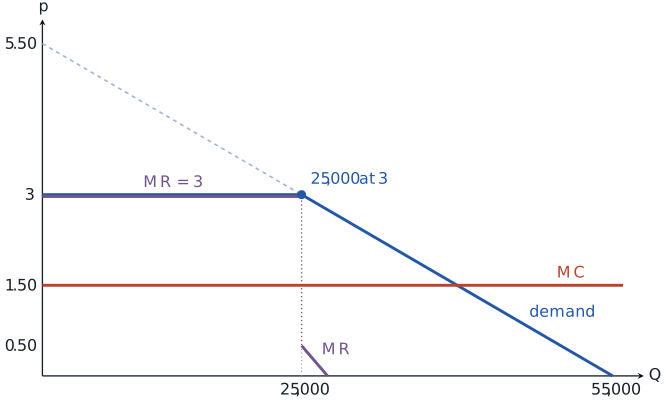
The mayor of Boston, a baseball fan and a populist, persuades the city council to cap the price of hotdogs at baseball games at $3. Show in a graph how the cap changes the vendor's marginal revenue. How many hotdogs does the vendor sell, and what happens to deadweight loss?
Reveal the solution
At $3, buyers want \(55{,}000-30{,}000=25{,}000\) hotdogs. Below 25,000, demand would allow a price above $3, but the cap prevents it. Selling one more hotdog doesn't lower the price of the others, so marginal revenue is $3. Beyond 25,000, the price has to fall below the cap, and marginal revenue returns to \(5.5-Q/5{,}000\), which is $0.50 at 25,000. Marginal revenue drops from $3 to $0.50 at 25,000 hotdogs:
Marginal revenue with the cap\(MR(Q)=\begin{cases}3 & \text{if } Q<25{,}000\\ 5.5-\dfrac{Q}{5{,}000} & \text{if } Q>25{,}000.\end{cases}\)
Marginal cost of $1.50 passes through the gap in marginal revenue at 25,000 hotdogs.
Marginal cost of $1.50 lies in the gap, so the vendor sells 25,000 hotdogs at $3, up from 20,000. Its profit falls to \(3\times25{,}000-(500+1.5\times25{,}000)=37{,}000\).
The efficient quantity is where demand meets marginal cost, at \(55{,}000-15{,}000=40{,}000\). Deadweight loss falls from \(\tfrac12(40{,}000-20{,}000)(3.5-1.5)=20{,}000\) without the cap to \(\tfrac12(40{,}000-25{,}000)(3-1.5)=11{,}250\) with it.
Compare the roses price ceiling in Week 3, which reduced the quantity sold. For a monopolist, a cap above marginal cost means that selling more no longer lowers the price of the other units, so quantity rises.