Mary Moy, an entertainment lawyer who represents several classical musicians, is organizing the New York debut of the Eberle String Quartet. She has narrowed the venue to two halls. Alice Tully Hall seats 1,500 and charges a flat rental of $30,000. Carnegie Hall seats 3,000 and charges a flat rental of $45,000.
The concert is outside both halls' subscription series, so Ms. Moy sets the ticket price. Whichever hall she chooses, she expects ticket sales to follow
Demand for tickets\(Q^d(p)=3{,}200-20p\)
where \(p\) is the ticket price in dollars. To keep things simple, she charges one price for every seat. Travel and other expenses come to $85,000 whichever hall she chooses.
Question 1
Which hall should Ms. Moy choose? What price should she charge per ticket?
Question 2
Carnegie Hall's management knows its main auditorium can be large for a debut, but it wants to keep presenting the best new artists. To compete with Alice Tully Hall, it offers a new contract for New York debuts. Ms. Moy would pay a flat $27,500 plus $15 for every ticket sold beyond 1,500. For example, if she sold 2,000 tickets, she would pay \(27{,}500+15\times500=35{,}000\).
Choosing among this new contract, the original Carnegie contract and Alice Tully Hall, what should Ms. Moy do? What price should she charge per ticket?
Reveal the solution
Solutions: Carnegie Hall
Question 1
Ms. Moy sets the ticket price, so she has market power over this concert. She should choose the number of tickets where marginal revenue equals marginal cost, subject to the hall's capacity.
Under either original contract, the rental is a flat fee and the $85,000 of travel and other expenses doesn't depend on ticket sales. Selling one more ticket costs nothing, so \(MC=0\).
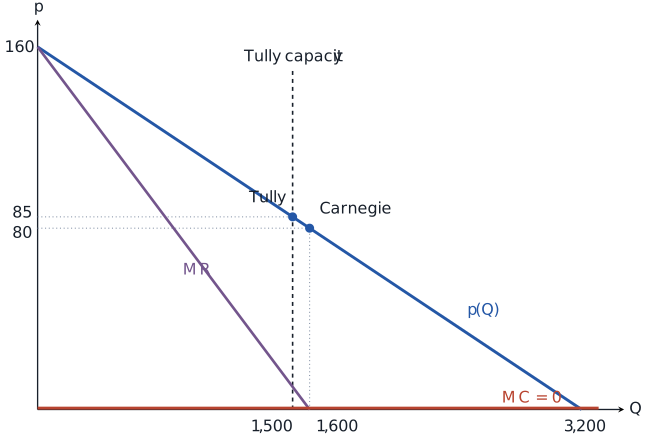
Without a capacity limit\(160-\dfrac{Q}{10}\)\(=\)\(0\)\(Q^m\)\(=\)\(1{,}600\)\(p^m\)\(=\)\(160-\dfrac{1{,}600}{20}\)\(=\)\(80\)
Carnegie Hall seats 3,000, so the capacity doesn't bind. Ms. Moy sells 1,600 tickets at $80.
Alice Tully Hall seats only 1,500. At that limit, \(MR(1{,}500)=160-150=10>0=MC\), so every seat adds revenue and she sells all 1,500. The price at which 1,500 tickets sell is
Ms. Moy should rent Alice Tully Hall and charge $85 a ticket. Carnegie's extra seats add only $500 of revenue, far less than its $15,000 higher rental.
Question 2
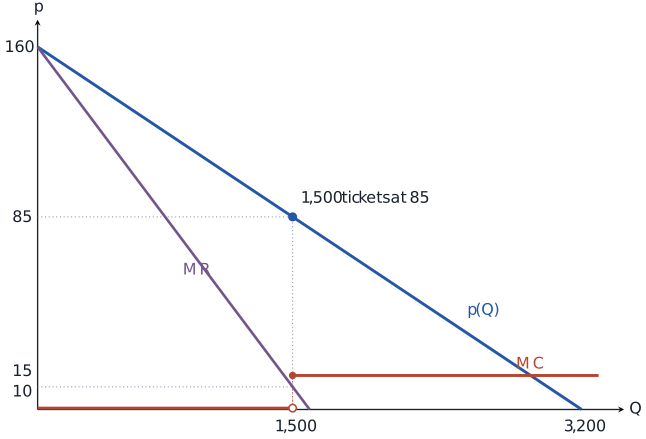
The new Carnegie contract changes marginal cost. The first 1,500 tickets cost nothing extra; each ticket beyond 1,500 costs $15:
Marginal cost under the new contract\(MC(Q)=\begin{cases}0 & \text{if } Q\le1{,}500\\ 15 & \text{if } Q>1{,}500.\end{cases}\)
At 1,500 tickets, \(MR(1{,}500)=10\). Below 1,500, marginal revenue is above 10 and marginal cost is zero, so Ms. Moy should sell at least 1,500. Above 1,500, marginal revenue is below 10 and marginal cost is 15, so each extra ticket loses money. She sells exactly 1,500 tickets at $85.
Marginal revenue passes through the jump in marginal cost at 1,500 tickets.
New Carnegie contract profit\(\pi_{\text{new}}\)\(=\)\(85\times1{,}500-(27{,}500+85{,}000)\)\(=\)\(127{,}500-112{,}500\)\(=\)\(15{,}000\)
This beats Tully's $12,500 and the old Carnegie contract's loss of $2,000. Ms. Moy should accept the new Carnegie contract and charge $85 a ticket.
Half of Carnegie's 3,000 seats stay empty, and that is the right decision. Filling them would require cutting the price for everyone, and the $15 fee makes even the 1,501st ticket unprofitable. Carnegie's contract works because it is cheaper than Tully's flat fee at exactly the quantity Ms. Moy wants to sell.