
Managerial Economics · Week 4
Monopolistic markets
How does a firm act when it has market power?
Market power
What does it take to set price?
One seller, no close substitutes, a barrier to entry.
Monopoly
Three conditions
- A single seller.
- No close substitutes.
- A barrier that keeps rivals out.
Barriers to entry
How persistent is the position?
| Barrier | Examples | Durability |
|---|---|---|
| Legal | Patents, licenses, exclusive contracts | Strong, but the law can change |
| Structural | Scarce inputs, natural monopoly | Lasts as long as the cost advantage |
| Strategic | Excess capacity, threats | Depends on credibility (Week 8) |
Market power
Who has market power?
Any firm that produces a unique product and solely dictates its demand dynamics.
The key difference
Price-taker and price-setter
Faces a flat demand curve at the market price. Chooses quantity only.
given \(p\)Faces the market demand curve. Chooses a price and quantity pair on it.
\(p=p(Q)\)Main example
Ride On
Children's rides in a shopping mall
\(Q^d(p)=140-40p\) rides per day
\(C(Q)=40+0.5Q\)
Daily rental 40, cost per ride 0.5
Ride On
Inverse demand
If Ride On wants to sell \(Q\) rides, the price must be \(p(Q)\).
Marginal revenue
What does one more sale change?
Selling more means charging less on every unit.
Ride On
Dissect the change in revenue
From \(Q\) to \(Q+\Delta Q\) rides
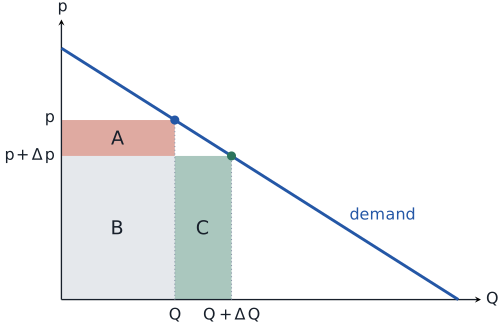
Marginal revenue
New revenue minus lost revenue
Marginal revenue
When revenue is continuous
Changes can be infinitesimally small: \(dQ\) and \(dp\).
\(p(Q)\): the price at which the extra unit sells
\(Q\times dp/dQ\): the discount on the units that were already selling
Linear demand
Same intercept, twice the slope
Ride On: \(MR=0\) at 70 rides, halfway to 140.
Monopoly pricing
Marginal comparison
Should Ride On run one more ride?
- \(MR>MC\): expand.
- \(MR\lt MC\): contract.
- \(MR=MC\): profit is at its peak.
Ride On
The monopoly solution
Check the neighbors
Profit peaks at 60 rides
| Rides | Price | Revenue | Cost | Profit |
|---|---|---|---|---|
| 40 | 2.50 | 100.00 | 60.00 | 40.00 |
| 50 | 2.25 | 112.50 | 65.00 | 47.50 |
| 60 | 2.00 | 120.00 | 70.00 | 50.00 |
| 70 | 1.75 | 122.50 | 75.00 | 47.50 |
| 80 | 1.50 | 120.00 | 80.00 | 40.00 |
Revenue peaks at 70 rides, profit at 60. Maximizing revenue isn't maximizing profit.
Two things the answer says
Above cost, below the maximum
Since \(MR\lt p\) and \(MR=MC\).
\(2>0.5\)At $3, Ride On sells 20 rides and earns 10.
\(\pi(20)=10<50\)The mall raises the rental
Rent rises from $40 to $60
Demand and the cost per ride don't change.
Fixed costs
The price stays at $2
A cost that doesn't vary with output affects whether the firm operates, not how much it sells.
Marginal cost rises
A ride now costs $1 to run
Marginal cost rose by 50 cents; the price rose by 25 cents.
In-class exercise
Fenway hotdogs
\(Q^d(p)=55{,}000-10{,}000p\) per game
\(MC=1.50\), fixed cost 500
Find price, output and profit
Then: only 10,000 hotdogs; a $3 price cap
Welfare
What does monopoly cost?
Separate the transfer from the loss.
Surplus at market scale
Consumer and producer surplus
Below demand, above the price.
\(\sum (WTP-p)\)Above marginal cost, below the price.
\(PS=\pi+\text{fixed cost}\)Ride On
Monopoly against the efficient outcome
| Monopoly | Efficient | |
|---|---|---|
| Price | 2.00 | 0.50 |
| Rides | 60 | 120 |
| Consumer surplus | 45 | 180 |
| Producer surplus | 90 | 0 |
| Total surplus | 135 | 180 |
Consumers lose 135. Ride On gains 90. The remaining 45 is deadweight loss.
Ride On
Deadweight loss
The loss is not the profit
Profit is a transfer from buyers. Deadweight loss is the value of trades that never happen.
Price controls
Same policy, opposite effect
A ceiling below equilibrium creates a shortage.
Fewer roses soldA cap above marginal cost removes the reason to restrict output.
More rides soldPatents
A monopoly created on purpose
Deadweight loss while the patent lasts.
Easy to measureInventions that would not otherwise exist, and disclosure.
Hard to measureElasticity
How large is the monopoly markup?
Can we estimate it without the whole demand curve?
Price elasticity of demand
A measure that doesn't depend on units
Elastic: \(|\varepsilon|>1\)
Unitary elastic: \(|\varepsilon|=1\)
Inelastic: \(|\varepsilon|<1\)
Ride On
Marginal revenue and elasticity
The markup rule
Ride On: \(\varepsilon=-\tfrac43\), so \((2-0.5)/2=\tfrac34\).
A diagnostic
Never on the inelastic part of demand
If demand is inelastic, a price rise raises revenue and lowers cost.
In-class exercise
U-Strap
At \(p=1{,}200\), \(\varepsilon=-4\) and \(MC=1{,}000\).
Assignment for Quiz 4
Carnegie Hall
Choose a concert hall and a ticket price, then evaluate a new contract.