
Managerial Economics · Week 3
Equilibrium in competitive markets
How does a competitive market reach and move in and out of equilibrium?
Short-run equilibrium
When do the two sides agree?
One market price must coordinate buyers and firms.
Demand and supply
Market Analysis
The demand-supply analysis sheds light on a market's dynamics based on its fundamentals.
Short-run adjustment
Market clearing
Competitive equilibrium
Every buyer and firm chooses optimally at the same price.
Market adjustment
Auto Eco market
Continue from Week 2
Ten identical firms
\(C(q)=80+10q+5q^2\)
\(q^s(p)=(p-10)/10\) above the threshold
\(Q^d(p)=170-p\)
Aggregate supply
Ten Auto Eco firms
Auto Eco market
Short-run equilibrium
At p = 70
Who cannot carry out their plan?
\(Q^d(70)=100\), \(Q^s(70)=60\)
Excess demand
A shortage pushes price up
Buyers compete for scarce output. Quantity demanded falls and quantity supplied rises along fixed curves.
At p = 110
Who cannot carry out their plan?
\(Q^d(110)=60\), \(Q^s(110)=100\)
Excess supply
Unsold output pushes price down
Sellers compete to clear inventory. Quantity demanded rises and quantity supplied falls along fixed curves.
Equilibrium
No pressure for price to move
A claim about consistent plans, not fairness or desirability.
One firm
What does equilibrium imply for Auto Eco?
Market price determines output; average cost determines profit.
Firm output
Use the market price
Firm profit
Revenue minus economic cost
Two cost measures
Don't confuse output with profit
Determines whether one more unit is worth producing.
\(p^e=MC(q^e)\)Determines the profit margin on output.
\(\pi^e(q^e)=[p^e-AC(q^e)]\times q^e\)Short-run equilibrium
Positive profit can persist
The number of firms is fixed for now.
Comparative statics
When a curve shifts
Compare the old and new equilibria, then explain the pressure between them.
Comparative statics
Four basic cases
Price and quantity
| Shift | Price | Quantity |
|---|---|---|
| Demand right | Rises | Rises |
| Demand left | Falls | Falls |
| Supply right | Falls | Rises |
| Supply left | Rises | Falls |
Demand shifts move price and quantity together. Supply shifts move them in opposite directions.
Both curves move
Demand right and supply left
Both shifts push in the same direction.
RisesThe two shifts pull in opposite directions.
AmbiguousLong run
Entry and exit
The number of firms becomes endogenous.
Entry and exit
Firms make entry and exit decisions in the long run
- An entrant compares profits in this market with its next-best alternative.
- An incumbent exits the market if it cannot earn economic profit.
- The number of firms in the market is determined by market dynamics.
Long-run costs
All resources can be adjusted
In the long run, firms can adjust all resources. So all options are feasible.
All costs are avoidable.
The difference between long-run and short-run costs equals the unavoidable costs.
In-class exercise
Apple seller at QVM
An entrepreneur from Red Hill sells apples at QVM.
He buys apples for $10 per case.
He rents a truck for $250 per day. The truck can carry 500 cases.
He hires one worker for $150 per day.
The City of Melbourne charges an annual $13,000 fee for a QVM stand license covering Saturdays. The license is non-refundable and non-transferable.
Once he pays the fee, it becomes unavoidable for a year.
In-class exercise
Long-run average cost
Average cost rises by \(250/q\) at every output level. The annual licence costs \(\$13{,}000\), or \(\$250\) per weekend over 52 weekends.
In-class exercise
Short-run and long-run average cost
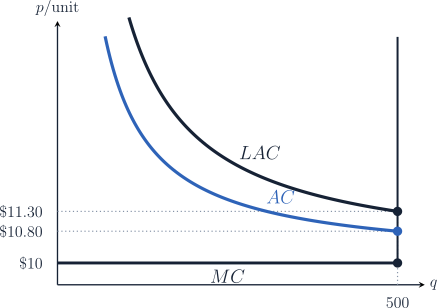
Entry and exit
Long-run market equilibrium
The long-run equilibrium determines the market price, the quantity traded and the number of firms in the industry.
- The equilibrium price \(p^e\) adjusts so that \(Q^d(p^e)=Q^s(p^e)\).
- There is no entry or exit in the market.
Long-run adjustment
Portakal
When entry is capped
Competitive behavior with a scarce right to produce.
Orange farming
The island
\(Q^d(p)=3{,}100-100p\)
\(C_i(q)=100+q+q^2\)
\(\min AC_i=21\) at \(q=10\)
At most fifty island farms
Orange supply in the island
Excess demand at the min AC
Equilibrium in the island
Restricted market supply
Island farmers' profit
Positive profits
There is no land in the market to enter.
Mainland farmers
A higher-cost technology
Transportation adds $2 per tonne.
\(C_m(q)=100+3q+q^2\)
\(\min AC_m=23\) at \(q=10\)
A large pool of mainland entrants pins price at 23.
Portakal with trade
One price, two profits
Cost advantage
The inferior technology enters until profit is zero.
\(\pi_M=0\)The superior technology earns a rent.
\(\pi_I=21\)Assignment for Quiz 3
The market for roses
Derive supply and equilibrium, then analyze Valentine’s Day demand and a $20 price ceiling.